
Mason City, IA & North Iowa
The 25% Rule for Mason City Buildings Explained
Building Types Most Likely to Trigger This Rule
Not every building in Mason City runs into the 25% rule. But certain types hit it more often than others, and we see the same patterns year after year. Older commercial buildings are the biggest repeat offenders. Think downtown Mason City near Federal Avenue or along South Federal. Those flat-roofed brick buildings from the 1940s and 1950s have had decades of patch jobs. One more big repair can push the total cost past that 25% threshold fast.
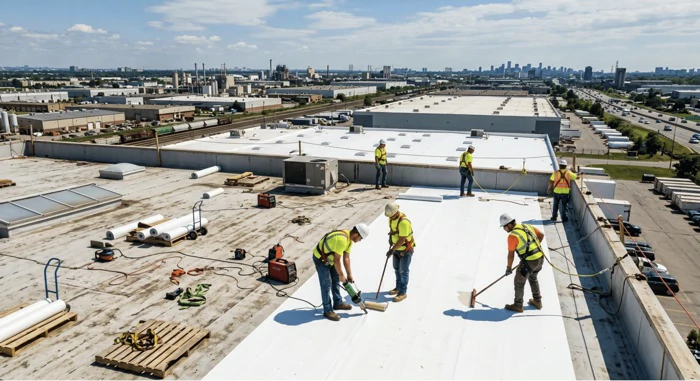
Flat Roof Commercial Buildings
Flat roofs take a beating. They pool water. They age unevenly. And when one section fails, the damage often spreads to the deck underneath. A building owner thinks they're fixing a small leak, then the contractor opens it up and finds rotted decking across half the roof. Suddenly the repair estimate jumps. That jump is what triggers the rule.
We've seen this play out on Mason City strip malls and office buildings more times than we can count. The owner budgeted for a flat roof repair, now they're looking at a flat roof replacement because the numbers crossed that line.
Multi-Unit Retail and Mixed-Use Properties
Buildings with multiple tenants create a tricky situation. Each unit might have its own HVAC penetration, its own drainage issues, its own history of leaks. The roof damage adds up across the whole structure. One tenant's problem becomes everyone's problem once the repair scope grows.
You'd think the 25% rule would only apply to the damaged section, but it doesn't. It looks at the entire building's value. A $400,000 building only needs $100,000 in total repairs before the rule kicks in. On a large commercial roof, that number isn't hard to reach.
Warehouses and Industrial Buildings
Big footprint means big roof. A warehouse roof in Mason City might be 15,000 square feet or more. Storm damage from hail or wind can affect the entire surface at once. We do a lot of storm damage inspections on these buildings, and the repair estimates climb fast when you're dealing with that much area.
Metal roofing on industrial buildings can also trigger the rule. If the standing seam panels are old enough, a partial replacement might not be code-compliant. The city could require you to bring the whole system up to current standards.
Buildings with Previous Unpermitted Work
This one catches people off guard. If your building had roof work done without permits in the past, those costs can still count. The building department tracks cumulative investment. Past repairs that were never inspected don't just disappear from the equation.
We've walked into situations where an owner thought they were doing a simple roof coating, only to learn that previous unpermitted repairs already put them close to the threshold. One more project tipped them over. The buildings most at risk share a few common traits:
- Built before 1980 with original or second-generation roofing systems
- Flat or low-slope roofs with a history of patch repairs
- Large square footage where storm damage affects the whole surface
- Previous work done without proper permits or inspections