
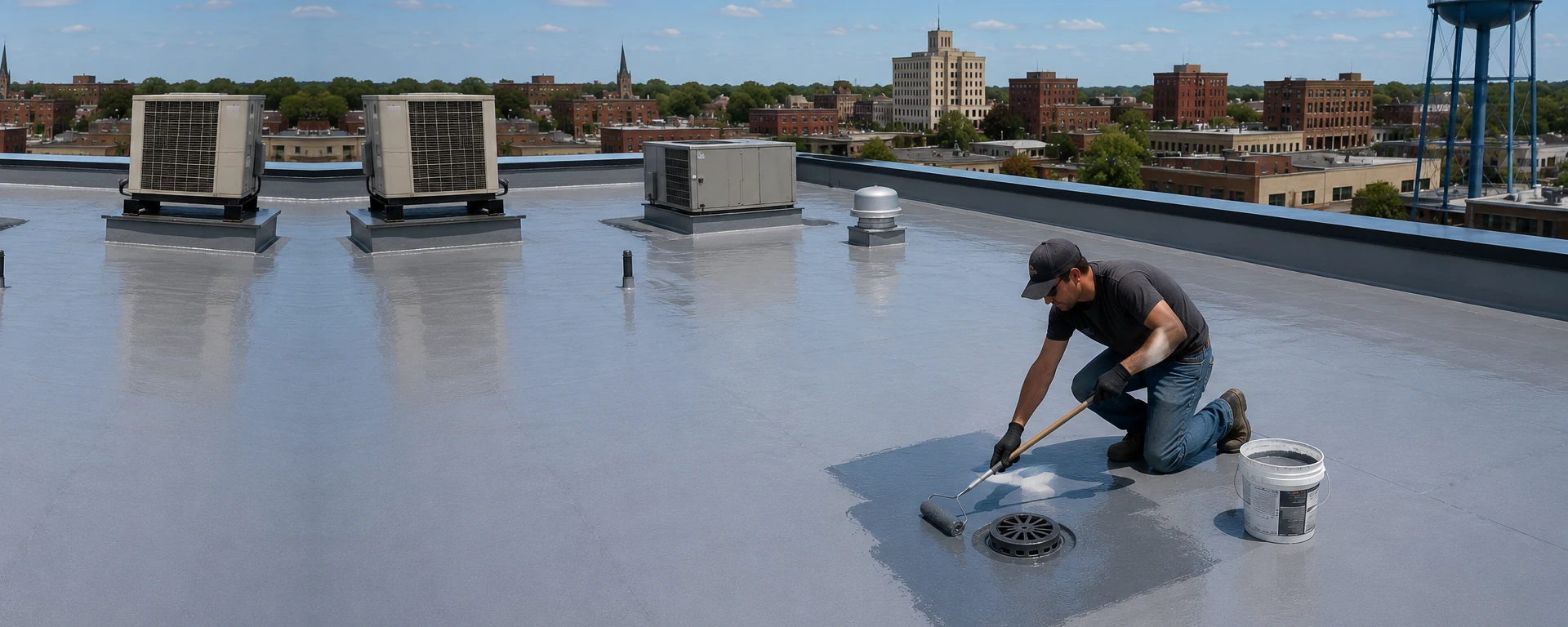
How Do You Install a Waterproofing Membrane in Mason City, IA?
A professional waterproofing membrane installation follows a clear sequence from substrate prep to final inspection. Here is what the process looks like:
- Inspect and assess the substrate — check for moisture, cracks, voids, and surface contamination that must be resolved before membrane application
- Clean the surface thoroughly and repair all cracks, joints, and penetrations with compatible filler or sealant
- Apply manufacturer-required primer to the prepared substrate and allow full cure before membrane installation begins
- Install the waterproofing membrane starting at the lowest point or most vulnerable area — drains, transitions, and penetrations first
- Overlap all seams to manufacturer-specified dimensions and bond or weld seams completely with no voids or bridging
- Install all flashing, transition strips, and termination details at edges, walls, and penetrations
- Inspect the completed installation for pinholes, unbonded seams, and incomplete transitions before any overburden or finish surface is applied
What Professional Waterproofing Membrane Installation in Mason City Actually Covers
A professional membrane installation covers far more than peeling and sticking a sheet to a surface. It includes substrate assessment and preparation, compatible primer application, membrane selection and layout planning, seam and overlap bonding, penetration and transition flashing, termination bar installation at edges, and a final inspection before any overburden is placed.
Mason City's freeze-thaw cycling subjects every membrane seam, transition, and termination edge to repeated thermal movement stress. Professional installation to manufacturer specifications is the only way to ensure the system accommodates that movement without delaminating or opening at critical junctions during lowa❜s first hard winter after installation. A-1 Roofing Services waterproofing solutions are installed to spec the first time, with documented prep, manufacturer-approved materials, and warranty-backed seam work. What a professional membrane installation covers:
- Full substrate inspection and moisture probe testing
- Crack, joint, and void repair with compatible filler or sealant
- Primer application and full cure before membrane begins
- Membrane layout planning to minimize seam count at high-stress locations
- Seam overlaps to manufacturer-specified dimensions — bonded or welded with no voids
- Penetration flashing — drains, pipes, vents, and HVAC curbs
- Transition detailing at inside and outside corners with cant strips where required
- Termination bar installation at all edge conditions
- Final inspection for pinholes, unbonded seams, and incomplete transitions
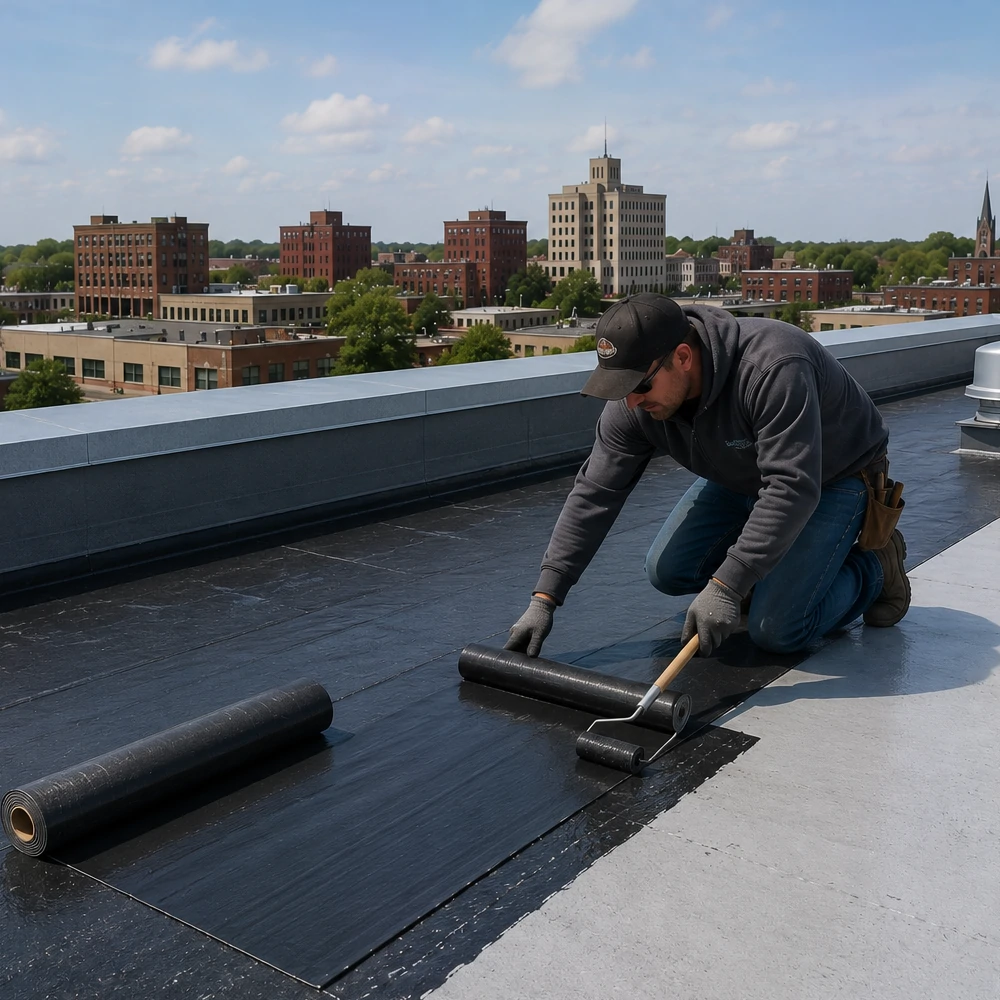
How to Choose the Right Waterproofing Membrane for Your Mason City Application
The right membrane depends on the application — roof deck versus below-grade foundation versus wall — plus the substrate material, traffic exposure, expected structural movement, and lowa❜s climate demands. A membrane that performs well in a warm, stable climate may crack, delaminate, or lose adhesion in Mason City's temperature range from -20°F to 100°F if it does not have the flexibility rating to match.
Self-adhering modified bitumen sheet membranes are the most common waterproofing membrane on Mason City residential roof applications — including ice and water shield at eaves and valleys. Below-grade foundation applications in Cerro Gordo County typically use HDPE dimple mat systems or fully adhered sheet membranes rated for soil contact and hydrostatic pressure from lowa❜s spring water table rise. Membrane types matched to Mason City applications:
- Self-adhering modified bitumen sheet — residential roof eaves, valleys, and penetrations
- Fully adhered TPO or EPDM — flat commercial roofing membranes with heat-welded or bonded seams
- Hot-applied rubberized asphalt — below-grade foundations and complex transitions with heavy hydrostatic exposure
- Liquid-applied polyurethane — roof decks, balconies, and irregular surfaces requiring seamless coverage
- HDPE dimple mat — below-grade exterior foundation walls with drainage layer combined
- Self-adhering HDPE sheet — below-grade applications requiring soil contact and root resistance
What Goes Into Proper Membrane Surface Preparation in Iowa Conditions
Surface preparation is the single factor that determines whether a waterproofing membrane bonds correctly and lasts through multiple Iowa freeze-thaw cycles. A surface that looks dry and clean on a warm afternoon may carry enough residual moisture from morning dew or recent rain to compromise adhesion across the entire installation. Experienced Mason City contractors verify surface dryness before primer goes on — not by looking, but by testing.
Iowa spring and fall installation windows are narrow. Morning dew, afternoon rain probability, and overnight temperature drops below membrane application minimums create scheduling challenges that require careful forecast monitoring. Specific preparation requirements that determine membrane performance:
- Surface dryness verification — probe testing or moisture meter, not visual assessment alone
- Crack and void repair with the specific filler compatible with the membrane chemistry
- Laitance removal on concrete surfaces — grinding or shot blasting to expose clean aggregate
- Compatibility confirmation between primer and membrane — incompatible products cause delamination
- Temperature and humidity confirmation — application windows vary by product and must be strictly followed
- Cant strip installation at inside corners before membrane — bridging without cant strips is one of the most common failure points
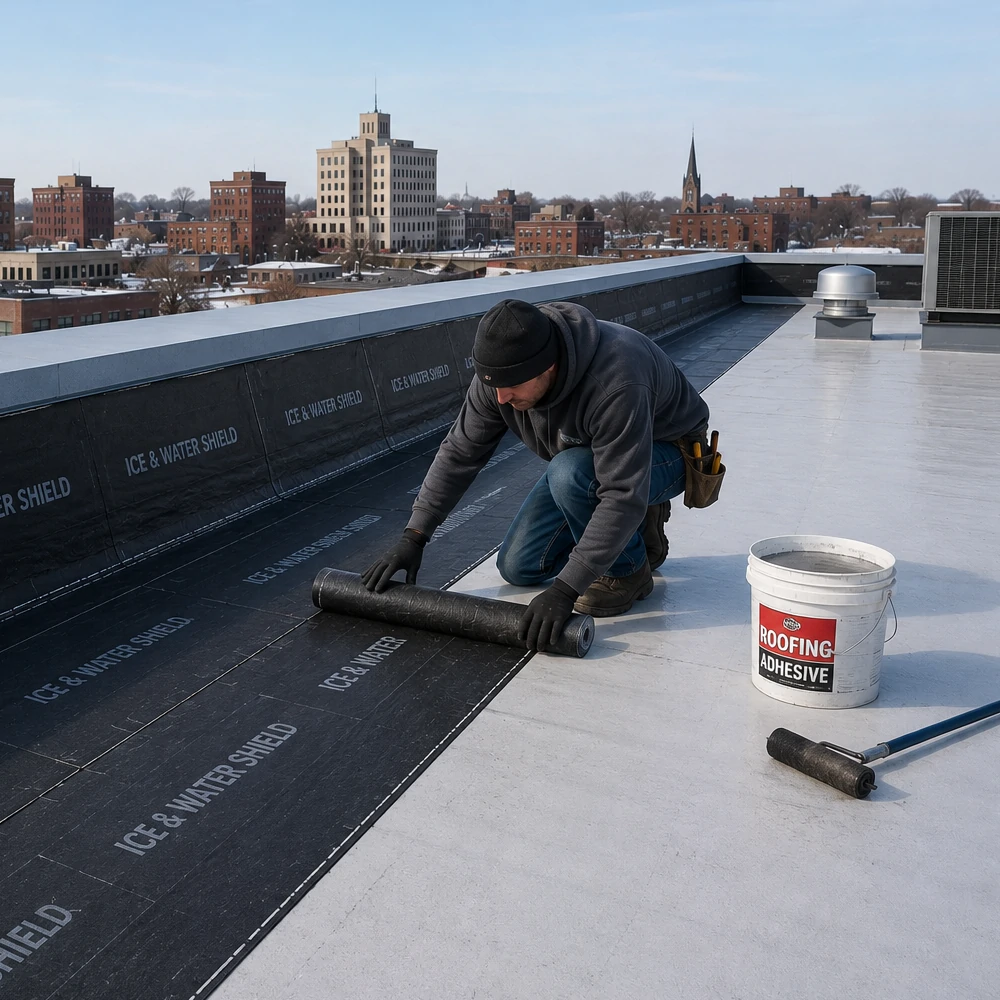
How to Avoid the Most Common Waterproofing Membrane Mistakes
The most common waterproofing membrane failure on Mason City projects is insufficient seam overlap combined with incomplete adhesion at transitions and inside corners. lowa❜s freeze-thaw cycling opens weakly bonded junctions progressively each winter. By the third or fourth freeze-thaw season, what started as a slightly under-lapped seam is an active leak path — at exactly the locations where proper detailing is most critical and most frequently rushed.
Mistakes that cause membrane failure in Mason City:
- Applying membrane to surfaces that contain residual moisture — appears dry, bonds poorly
- Skipping manufacturer-required primer — membrane bonds to contamination, not the substrate
- Insufficient seam overlap dimensions — opens under freeze-thaw thermal movement
- Bridging at inside corners without cant strips — membrane spans the void and splits
- Incomplete penetration detailing — water tracks into the system at every unflashed pipe and drain
- Applying outside temperature or humidity application windows — bonding is compromised from installation day
- Rushing primer cure time — membrane applied before primer fully dries bonds only to the wet primer layer
How Long Waterproofing Membranes Last in North Iowa and What Extends Their Life
Self-adhering modified bitumen sheet membranes last 15 to 25 years in Iowa. Fully adhered TPO and EPDM systems last 15 to 30 years. Hot-applied rubberized systems last 20 to 30 years. Liquid-applied systems last 10 to 20 years. All of these lifespans assume correct installation and biannual inspection with prompt repair of any edge or seam separations.
The April post-winter inspection is the most important maintenance window for any waterproofing membrane installation in Mason City. Freeze-thaw cycling stresses termination edges, transition flashings, and seam areas that experienced thermal movement during winter. Maintenance steps that extend membrane lifespan:
- April inspection after freeze-thaw season — check all termination edges, seams, and transition flashings
- October inspection before winter — confirm no open laps or separated termination bars
- Prompt resealing of any separation found — compatible sealant applied before any moisture enters
- No overburden or finish surface changes without confirming membrane compatibility
- Keep all installation and inspection records for warranty and insurance documentation
- Coordinate any work on the deck or surface above — penetrations added after installation require membrane patching to spec