
Home / Balcony Waterproofing in Mason City, IA, Protect What Is Below Before Iowa Weather Finds the Weakness / How Long Does Balcony Waterproofing Last in Iowa's Climate?
By A1 Roofing · Published 2026-09-25 · Last updated 2026-09-25
How long does balcony waterproofing last in Iowa's climate depends on the system installed and how consistently it's maintained. Traffic-bearing polyurethane membrane systems last ten to twenty years. Liquid-applied EPDM systems last ten to fifteen years. Surface coating systems last five to eight years. Every lifespan shortens without regular inspection and prompt repair of railing post bases and transition flashings, the spots most stressed by Iowa's freeze-thaw cycle. Mason City and the surrounding North Iowa region average more than 140 freeze-thaw days per year, which puts far more pressure on waterproofing membranes than milder climates do. A spring inspection after winter stress is visible but before summer heat sets cracks deeper is what separates systems that reach their rated life from ones that fail years early.
What types of balcony waterproofing systems are used in Iowa?
Three main system types are used on Iowa balconies: traffic-bearing polyurethane membranes, liquid-applied EPDM, and surface coatings. Each performs differently under North Iowa's weather conditions, and the system you choose determines both upfront cost and how many years your deck stays watertight.
What is a traffic-bearing polyurethane membrane?
A traffic-bearing polyurethane membrane is a multi-layer system built from a liquid-applied polyurethane base coat, a reinforcing fabric, and a UV-resistant topcoat. The multi-layer build creates redundancy: if the topcoat weathers, the reinforcing layer below still holds moisture out. That construction lets the membrane flex under foot traffic without cracking and gives the system enough body to bridge small substrate imperfections.
What is a liquid-applied EPDM system?
Liquid-applied EPDM is a rubber-based coating mixed and applied in liquid form, then cured into a continuous sheet directly on the deck substrate. EPDM rubber stays flexible at very low temperatures, which makes it well suited to Iowa winters where decks contract sharply overnight. Because there are no seams, liquid-applied EPDM removes one of the most common failure points found in sheet-membrane systems. That's not a small thing in a climate like ours.
| System type | Typical lifespan | Key Iowa-climate trait |
|---|---|---|
| Traffic-bearing polyurethane membrane | 10–20 years | Handles foot traffic and freeze-thaw flexing |
| Liquid-applied EPDM | 10–15 years | No seams; stays flexible in cold temperatures |
| Surface coating | 5–8 years | Thin protective layer; shortest service life |
How long does each balcony waterproofing system last in Iowa's climate?
In Iowa's climate, traffic-bearing polyurethane membranes last ten to twenty years, liquid-applied EPDM lasts ten to fifteen years, and surface coatings last five to eight years, all with proper maintenance. These aren't guarantees; they're the ranges a system can reach when installation is done correctly and inspections happen on schedule.
Skip maintenance and every range shrinks. A system rated for fifteen years can fail well before year ten if a cracked flashing goes unrepaired through two or three freeze-thaw seasons. Iowa's more than 140 freeze-thaw days per year put mechanical stress on every membrane that a milder climate simply wouldn't.
Lifespan isn't fixed by system type alone. Installation quality matters as much as the product. A perfectly formulated polyurethane membrane applied to a damp or poorly primed substrate will delaminate long before year ten. Ongoing care is what determines where a system lands within its rated range, not just the product spec sheet.
Why does Iowa's freeze-thaw cycle shorten balcony waterproofing life?
Mason City and the surrounding North Iowa region average more than 140 freeze-thaw days per year, and each cycle forces water trapped in tiny cracks to expand and contract, widening gaps every single time. According to the U.S. Geological Survey Water Science School, water expands roughly nine percent in volume when it freezes. A hairline crack that's barely visible in October can become a measurable gap by late March after dozens of freeze-thaw cycles have worked it open.
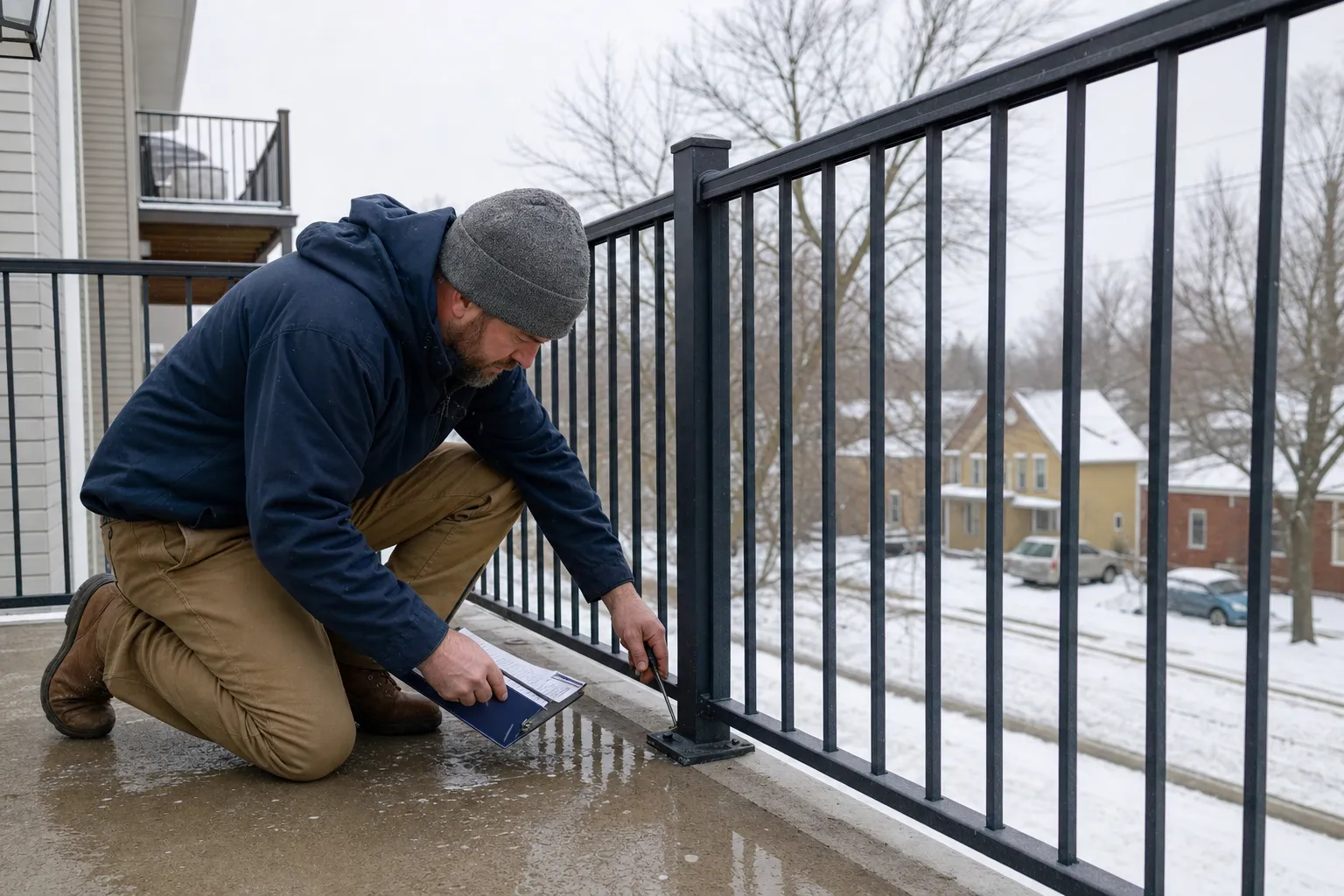
The areas that collect the most water and experience the most movement are railing post bases and transition flashings, the joints where the deck membrane meets a wall, a curb, or a vertical post. Water pools naturally at these junctions. When that water freezes inside a micro-gap, the ice acts like a small wedge forcing the membrane away from the substrate. We see this pattern on balconies across Mason City every spring, and it's preventable when you catch it before winter sets in.
A system installed correctly in autumn can show its first stress cracks by late March if the substrate held moisture through winter. That's not a product failure. That's Iowa weather doing what it does to any material that isn't inspected and maintained on a regular schedule.
Which balcony spots fail first in Iowa winters?
Three zones carry the highest failure risk on any balcony in North Iowa. Every post base is a hole in the membrane, and the sealant at those points hardens and shrinks over freeze-thaw cycles, creating a gap water finds immediately. The perimeter flashing, the membrane edge where deck meets wall, is the longest seam on the balcony, and differential movement between the deck and wall structure stresses that joint every winter. Drains are the third problem area: water concentrates there, and if the collar seal between the membrane and the drain body separates, water bypasses the membrane entirely and reaches the structural deck below. By the time you notice it from inside, it's been going on a while.
What maintenance keeps balcony waterproofing lasting its full rated life?
Regular inspection, once in spring after freeze-thaw season ends and once in autumn before temperatures drop, is among the most effective practices for keeping any balcony waterproofing system reaching its rated lifespan. Inspecting at both points in Iowa's seasonal cycle catches damage when it's smallest and most repairable.
Why is the spring inspection timing important in Iowa?
Spring is the right window for a post-winter inspection in North Iowa. After the last freeze-thaw cycles of the season have run their course, winter damage is fully visible. At the same time, summer UV heat hasn't yet had the chance to set cracks deeper or accelerate surface coating oxidation. Catching a lifted seam or a cracked post base in spring means the repair is a small one. Waiting until midsummer means the same crack has been working through heat expansion cycles for additional months.
The autumn inspection serves a different purpose. Done before the ground freezes, it confirms that all drains are clear of debris, that transition flashings are still tight, and that no summer damage was missed. A clogged drain heading into a North Iowa winter creates ponding water that can freeze solid on the deck surface, adding weight and forcing water under any loose membrane edge. That's one of the most avoidable failures we see, and it costs a lot more to fix than a drain cleaning would have.
At each inspection, work through these specific points: check every railing post base for cracked or receded sealant; look over transition flashings at all walls and curbs for lifted edges; clear all drains and confirm water moves freely off the deck surface; scan the full membrane field for bubbles or lifted seams; note any discoloration that could signal trapped moisture under the membrane. Finding a problem and deferring the fix gives Iowa weather another season to make it worse.
What signs mean a balcony waterproofing system is failing early?
Visible bubbling, lifting seams, discoloration around railing posts, and water stains on the ceiling below are the clearest signs that a balcony waterproofing system is breaking down ahead of schedule.
Bubbles under the membrane mean water is already trapped between the coating and the deck substrate. Once that bond is broken, water moves laterally under the membrane and the affected area grows with every rain.
Lifting or cracked seams at wall transitions and post bases give water a direct path to the structural deck below. These aren't cosmetic issues. A cracked seam at a railing post base can direct water straight down through the framing with no visible exterior sign until the damage is already done. Staining or efflorescence, the white mineral deposit left when water carries salts through concrete, on the concrete or ceiling below the balcony tells us water has been moving through for weeks or months, not days.
Early failure is tied to one skipped inspection or one unrepaired flashing, not a defective product. Catching these signs in year three or four is far less costly than finding structural deck rot in year six.
When should a balcony waterproofing system be replaced rather than repaired?
Replacement is the right call when the membrane has failed in multiple locations, when the deck substrate shows rot or delamination, or when a surface coating system has exceeded its rated eight-year service window without re-coating.
Spot repairs work well when failure is isolated to one or two flashing joints and the rest of the membrane is still tightly bonded to the substrate. A single cracked post base on an otherwise sound polyurethane membrane doesn't justify pulling the entire system. That's a repair job. When repair costs start to approach replacement costs, we'll tell you honestly which side of that line you're on. A full system replacement starts the service clock over rather than extending a failing one, and we'll give you a written scope that makes the cost comparison clear.
A liquid-applied EPDM system that remains bonded and intact may need only targeted seam and drain collar work rather than full removal, though we need to see the deck to say that with confidence. A surface coating with widespread cracking at or beyond year seven has run its course, and the right next step is checking the substrate condition before deciding between re-coating and a new system.
If you're weighing repair against replacement on a Mason City deck and want a written assessment with photos, our professional balcony waterproofing in Mason City service page covers the full scope of what that evaluation looks like.
How does heavy snow and hail affect balcony waterproofing in North Iowa?
North Iowa's heavy snow loads and frequent hail events both accelerate membrane wear. Snow adds static weight that stresses seams over weeks, while hail impact can puncture or crack thinner surface coating systems in a single storm.
Accumulated snow that melts slowly creates sustained ponding at drains. This is the same failure mode we see on flat commercial roofs across Mason City's older building stock: water sits longer than the membrane was designed to handle, and seam edges begin to lift under constant hydrostatic pressure. On a balcony, a clogged drain turns a light snowmelt into a multi-day ponding event. Ice dams can form at balcony perimeters in the same way they form at roof eaves. Meltwater runs toward the edge, refreezes at the cold perimeter, and backs up under flashing edges that appear perfectly sound from above.
Mason City and Cerro Gordo County sit in a region with regular severe thunderstorm seasons from April through September. Hail events in this area aren't rare, and a post-storm membrane check should be a routine habit, not an emergency response.
Does hail damage affect balcony waterproofing coverage?
Whether hail damage affects manufacturer coverage depends entirely on the specific product and the terms of that manufacturer's warranty — review your warranty documentation directly. Whether it may be documentable under a property insurance claim is a question for your insurer.
The practical step after any significant hail event is a visual inspection of the membrane surface for impact marks, small punctures, or cracked topcoat sections. Documenting the membrane condition promptly, before the next rain exposes the deck to water through any new punctures, protects your options regardless of how coverage questions are resolved.
What it comes down to
Balcony waterproofing lifespan in Iowa's climate ranges from five years for surface coatings to twenty years for well-maintained polyurethane membrane systems. The difference between hitting the top of that range or the bottom comes down to catching damage while it's still small. North Iowa's 140-plus freeze-thaw days per year aren't negotiable, but what those cycles do to your deck is manageable when you stay ahead of it. If your deck is showing bubbles, lifted seams, or staining below, we'd rather you call before another Iowa winter adds to the problem.