
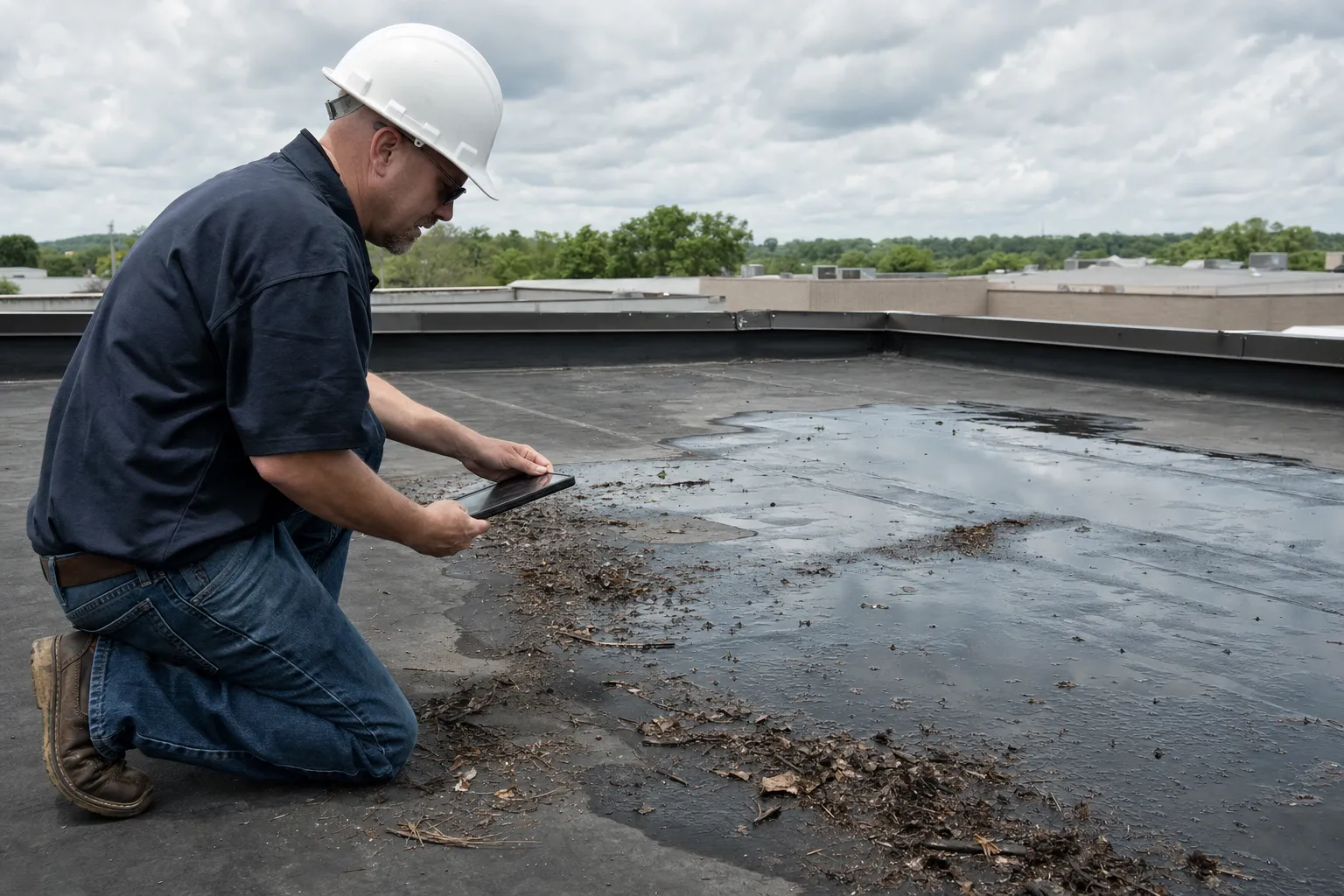
Commercial insurance covers roof leaks in Mason City when the leak is caused by a sudden, covered event, typically hail, high winds, or a falling tree. Leaks from age, deferred maintenance, or gradual membrane wear are almost always excluded. Iowa commercial property policies treat the cause of the leak, not just the leak itself, as the deciding factor. Property managers who document damage before repairs begin and obtain a written contractor report tied to a specific storm date give their claim the strongest possible foundation. Slow-developing leaks with no traceable storm origin are rarely approved. Understanding this cause-first framework before you file saves time, protects the building, and reduces the risk of a denied claim showing up on your policy record.
What types of roof leaks does commercial insurance actually cover?
Commercial property insurance covers roof leaks caused by sudden, accidental events, not gradual wear or neglect. The triggering cause must match a listed "covered peril" in the policy, or the claim won't move forward.
Events that typically fall within commercial coverage:
- Hail strikes that puncture or crack TPO, EPDM, or PVC membrane surfaces
- Straight-line wind damage that lifts flashing, tears membrane edges, or separates seams
- Tornado-adjacent storm systems that damage low-slope roof assemblies
- Falling trees or debris that physically breach the roof membrane
Events that are typically excluded:
- Membrane cracking or seam separation caused by age and repeated freeze-thaw stress
- Ponding water damage resulting from clogged or undersized roof drains
- Leaks traced to deferred flashing maintenance or worn pipe penetration seals
- Gradual deterioration of modified bitumen or built-up roofing systems over time
Then there are the gray-area scenarios, and there are more of these than most property managers expect:
- A membrane that shows both a fresh hail strike and pre-existing blistering
- A leak that worsened after a storm but began months before the storm date
- Wind-lifted flashing on a section of roof that also shows long-term corrosion
Is hail damage to a flat commercial roof covered in Iowa?
Hail damage to TPO and EPDM membranes is generally a covered event under Iowa commercial property policies, provided the impact is traceable to a specific storm date. Mason City and Cerro Gordo County sit in an active severe-weather corridor with regular hail events from April through September, making this one of the most common storm-damage claims we see in the region. An adjuster will look for impact craters, granule displacement, or membrane punctures consistent with the reported hail size.
Does wind damage to commercial roof flashing count as a covered event?
Wind damage to flashing and membrane edges qualifies as a covered event when the damage is sudden and traceable to a specific high-wind event. North Iowa's flat terrain gives wind systems little resistance, and the same storm that produces moderate gusts in a sheltered city can produce significantly stronger gusts across open commercial districts in Mason City. Lifted flashing and torn membrane perimeters from those events fall within standard sudden-damage language in most Iowa commercial policies.
What roof leak causes are excluded from commercial coverage?
Leaks caused by age, deferred maintenance, ponding water from clogged drains, or gradual membrane wear are nearly always excluded from commercial property claims. Insurers treat slow deterioration as a maintenance obligation, not an insurable event, so the property owner bears that cost directly.
Flat and low-slope commercial roofs in Mason City average more than 140 freeze-thaw cycles per year. That repeated expansion and contraction accelerates membrane cracking, seam failure, and flashing separation. When a leak traces back to that type of cumulative stress, insurers classify the damage as wear, not storm damage, regardless of whether a storm occurred near that time.
Heavy snow loads and ice dams are a related concern. North Iowa's winter conditions regularly stress flat-roof membranes with accumulated weight and freeze-thaw moisture intrusion. If the resulting leak traces back to seasonal snow loading rather than a single identifiable storm event, coverage is unlikely.
Does ponding water on a flat roof affect an insurance claim?
Ponding water, meaning water that remains on a flat roof surface more than 48 hours after precipitation ends, is treated by most insurers as a maintenance and drainage failure. A leak that develops from a membrane softened by long-term ponding will typically be excluded from coverage. Clogged drains, inadequate roof slope, and undersized scuppers are all maintenance issues an insurer expects a property owner to address proactively. If an adjuster finds ponding evidence alongside storm damage, the claim may be split or partially denied.
Pre-existing damage that was known but left unrepaired before a storm creates another exclusion risk. If an adjuster can show the property had documented leak history before the storm worsened the opening, the insurer may reduce or void the claim, even if the storm clearly contributed to the current damage. We've seen that scenario end badly for property owners who assumed the storm would carry the whole claim.
How do you document a commercial roof leak for an insurance claim?
Document the damage before any repairs begin. Photos, dates, and a written contractor report tied to the specific storm event form the foundation of a strong claim. The sequence matters as much as the content.
Here's how to build a documentation package an adjuster can act on:
Photograph all visible damage immediately after the storm. Capture interior water intrusion, membrane tears, hail impact craters, lifted flashing, and any displaced debris. Use timestamps on every photo.
Record the storm date and cross-reference it with National Weather Service records for Cerro Gordo County. Official storm data confirms that a covered event actually occurred on the date you report. Adjusters routinely check this data themselves.
Get a written damage assessment from a licensed, insured roofing contractor. The report should identify the probable cause, describe the specific damage, and connect both to the storm event, not simply list repair needs and costs.
Notify your insurer promptly. Most Iowa commercial property policies include a reporting window. Delays after a storm can complicate or limit a claim, even when the damage is clearly covered.
Keep all documentation in a single file for the adjuster. This includes inspection photos, the contractor's written report, storm-date weather records, temporary-repair invoices, and all insurer correspondence.
What should a contractor's storm damage report include?
A contractor's report carries the most weight when it names the specific storm date, identifies the membrane system type (TPO, EPDM, PVC, or other), describes each damage location by roof zone, states the probable cause for each failure, and distinguishes storm-caused damage from pre-existing wear. A report that lists repair costs without addressing cause gives an adjuster room to reclassify the damage as maintenance. The more specific and causal the contractor's language, the less interpretive room the insurer has.
Why does the cause of a roof leak matter so much to Iowa insurers?
Iowa commercial property policies are written around the concept of a "covered peril." The specific cause must match a listed event for a claim to move forward. The leak itself isn't the trigger; the cause of the leak is.
When the cause is ambiguous, adjusters default to exclusion language. That's why a contractor's written causal assessment carries more weight than photographs alone. Photos show what happened. A qualified contractor's report explains why it happened and connects the damage to a specific event.
What is a covered peril in a commercial property policy?
A covered peril is a specific event or cause of loss that an insurance policy agrees to pay for. Common covered perils in Iowa commercial property policies include fire, hail, wind, lightning, and falling objects. Exclusions typically include wear and tear, gradual deterioration, settling, and maintenance failures. If the cause of a roof leak falls under an exclusion, the policy won't pay regardless of how severe the leak is.
Iowa doesn't require a state-level roofing contractor license. Licensing is governed at the local municipality level. Because barriers to entry in the Iowa roofing market are low, insurers and adjusters pay close attention to whether the contractor providing a damage report carries local licensing, current insurance, and manufacturer certifications. Those credentials add credibility to the report. A contractor without verifiable credentials produces a report that an adjuster is more likely to question.
A flat-roof membrane that shows both a storm puncture and pre-existing blistering may produce a partial claim. The insurer covers the portion attributable to the storm and excludes the portion attributable to wear. Separating those two damage types accurately requires hands-on knowledge of how TPO, EPDM, and PVC membranes each fail under different stress conditions. How a TPO membrane fails under hail is not the same as how EPDM fails under freeze-thaw stress, and misidentifying one for the other in a report is something an experienced adjuster will catch.
What happens if you repair a commercial roof before the adjuster inspects it?
Repairing a commercial roof before an adjuster inspects it can reduce or void the claim. But doing nothing while the building leaks causes additional damage that may also hurt the claim. Both outcomes are bad. The practical path runs between them.
Emergency mitigation is the right first step. Tarping, temporary patching, and interior protection stop active water intrusion without permanently altering the physical evidence. Every emergency step should be photographed before and after, and all materials used should be documented. Temporary repairs should be labeled as temporary in any contractor invoice.
What counts as emergency mitigation versus a permanent repair for insurance purposes?
Adjusters generally accept emergency mitigation as necessary protective action. Tarps, temporary patches applied to the surface without removing existing membrane, and interior drying measures all fall within that category. A permanent repair — membrane replacement, new flashing installation, or full section tear-off — removes the physical evidence the insurer needs to validate the storm-damage claim. That line is what matters to the adjuster.
Keep the original damaged materials if any membrane sections are removed during emergency patching. Set them aside and photograph them with a label noting when and where they were removed.
Same-day response from a local, owner-operated contractor gives a property manager the fastest path to protect the building without compromising the claim. A contractor who can reach the site the day the storm hits can photograph original damage conditions, perform documented temporary mitigation, and produce a written report, all before the evidence is disturbed.
How does Mason City's storm climate affect commercial roof insurance claims?
Mason City sits in a region with frequent severe thunderstorms, hail, and high straight-line winds. Storm-related commercial roof claims are genuinely common in Cerro Gordo County. Not edge-case events, we respond to them every season.
The April-through-September hail season means commercial property managers in North Iowa face repeated storm exposures each year. Policies written for this region often reflect that risk in deductible structure and in the level of scrutiny adjusters apply to storm-damage claims. A claim that would receive minimal review in a low-hail-frequency market may receive a more detailed inspection in Mason City.
Does North Iowa hail frequency affect commercial roof insurance deductibles?
Many Iowa commercial property policies include a separate wind and hail deductible that is higher than the standard all-peril deductible. In high-frequency hail markets like Cerro Gordo County, that separate deductible is common. Review your policy's deductible structure before filing a storm-damage claim, because a hail deductible can reduce or eliminate the net payout on smaller repairs. Know that number before you pick up the phone to file.
North Iowa's flat terrain amplifies wind exposure. A storm system that produces 60 mph gusts in a sheltered market may produce stronger gusts across open farmland and commercial districts near Mason City, raising the probability of membrane edge failures, flashing lift, and penetration seal damage on flat and low-slope commercial roofs.
Older flat-roofed main-street and industrial buildings in Mason City carry additional exposure. Aged membranes that have already absorbed years of freeze-thaw stress and snow loading have less capacity to absorb a hail strike without visible, claim-eligible damage. A building with clear maintenance records and recent inspection documentation is harder for an insurer to reclassify as neglected, so those records are a practical claims-management asset, not just a roofing best practice.
When should you call a commercial roofing contractor before filing a claim?
Call a licensed commercial roofing contractor before you file, not after, so the written damage assessment arrives with your claim rather than as an afterthought. Filing without a contractor report puts the adjuster's interpretation at the center of the claim rather than a contractor's causal findings, and that's not a position you want to be in.
A contractor who works specifically on flat and low-slope commercial roofing can distinguish storm-caused membrane failure from age-related wear. That distinction is exactly what an adjuster evaluates. A contractor without flat-roof experience may not recognize the difference between a fresh hail impact on a TPO membrane and a pre-existing blister, and a report that misidentifies the cause damages the claim.
What questions should you ask a roofing contractor before an insurance claim?
Before engaging a contractor for a pre-claim inspection, ask:
- Are you licensed and insured in Mason City? Iowa licensing is local, so confirm the contractor meets Cerro Gordo County requirements specifically.
- Do you carry manufacturer certifications for the membrane systems on my building? Certifications for TPO, EPDM, or PVC systems indicate hands-on training on the specific materials being assessed.
- Will you provide a written report that identifies the cause of each damage item? A repair estimate isn't the same as a causal damage assessment.
- Can you distinguish storm damage from pre-existing wear in your report? The claim's outcome depends on that distinction being clearly stated.
- Will the report reference the specific storm date and connect the damage to that event? Adjusters require a clear causal chain from storm to damage to claim.
Property managers overseeing older flat-roofed buildings in Mason City can start with a commercial roof repair assessment in Mason City to get the causal documentation in hand before an adjuster visits. A written inspection report with photos from a contractor carrying local licensing, insurance, and manufacturer certifications carries more weight with adjusters than a verbal quote or a generic repair list.
The bottom line
Whether commercial insurance covers a roof leak in Mason City comes down to cause. Sudden storm events are typically covered; age and maintenance gaps are not. Documentation tied to a specific storm date and a licensed contractor's written causal report are the two variables you control most directly. North Iowa's hail frequency, 140-plus freeze-thaw cycles per year, and flat-terrain wind exposure make proactive inspection records a practical claims tool, not just a maintenance habit. Property managers who need a written damage assessment before contacting their insurer can find flat-roof and membrane repair options on the commercial roof repair in Mason City page, same-day response, written findings with photos, no sales pressure.