
By A1 Roofing · Published 2026-09-26 · Last updated 2026-09-26
Yes. Do balconies need to be waterproofed in Mason City? Any balcony built over a living space, conditioned room, or structural building component does. Surface sealers and deck stains protect only the walking surface. Water still reaches structural components through joints, fastener holes, and transitions. Mason City averages over 140 freeze-thaw days per year. Each freeze-thaw cycle forces water deeper into any unprotected gap and widens it. A proper waterproofing membrane bonds to the deck substrate and bridges every discontinuity in the assembly. Without one, water damage to the framing and interior space below isn't a possibility. It's a matter of time.
What is balcony waterproofing?
Balcony waterproofing is the installation of a continuous membrane system that stops water from moving through the deck structure into the space below. It's not a paint, stain, or surface treatment. It's a bonded layer that bridges joints, fastener penetrations, and deck-to-wall transitions.
A complete system includes the membrane itself, flashing at all edges and transitions, and proper slope or drainage so water moves off the surface rather than pooling. The goal is to protect the structural framing, concrete, or wood substrate underneath, not just the walking surface you can see.
What materials are used in balcony waterproofing membranes?
Two main membrane types cover most balcony applications. Fluid-applied membranes are liquid coatings that cure into a flexible, continuous barrier. A contractor brushes or rolls the material directly onto the substrate, and the membrane conforms to irregular surfaces and complex details without seams. Fluid-applied systems work well on decks with many penetrations or unusual geometry.
Sheet membranes are pre-manufactured rolls of material, often modified bitumen or synthetic polymer sheets, that are adhered or heat-welded to the deck surface. Sheet membranes deliver consistent thickness across the full field of the deck, though they require precise seam work at laps and transitions. A poorly made seam will fail eventually, and that's one of the most common things we find when we're called in to diagnose a leak.
Which type suits a given deck depends on the substrate material, the complexity of the details, and whether the deck will receive a finish wear course for foot traffic.
Why does Mason City's freeze-thaw climate make waterproofing essential?
Mason City averages over 140 freeze-thaw days per year, and every small gap in an unprotected deck becomes a larger crack each time water freezes inside it. Water expands roughly 9 percent when it freezes. Concrete, wood, and grout joints can't absorb that repeated force indefinitely.
Freeze-thaw cycling accelerates seam failure, fastener-hole widening, and flashing separation, which are the exact entry points where water finds structural framing. North Iowa also receives heavy seasonal snow loads. Melt water from snow sitting on a balcony deck is a slow, sustained moisture source, not just a brief rain event. Most people don't account for that when they're deciding whether to put off waterproofing another season.
How many freeze-thaw cycles does Mason City experience?
Mason City's 140-plus freeze-thaw days per year place the city among the more demanding climates in the Midwest for deck assemblies. Repeated freezing and thawing degrades concrete, mortar, and wood fiber over time, even when individual temperature swings are modest.
The freeze-thaw failure sequence on an unprotected balcony deck follows a consistent pattern:
- A gap forms at a joint, fastener hole, or crack in the deck surface.
- Water enters the gap during rain or snowmelt.
- Water freezes inside the gap when temperatures drop below 32°F.
- The gap widens as ice expansion puts pressure on the surrounding material.
- The wider gap admits more water in the next thaw cycle, and the process repeats.
Hail is also frequent across Cerro Gordo County from April through September. Hail impact damage to an unprotected deck surface creates new penetration points that are easy to miss until water has already moved through the assembly.
What happens if a balcony over a living space is not waterproofed?
When a balcony over a living space has no waterproofing membrane, water eventually reaches the structural framing, insulation, and interior ceiling of the room below. Structural framing, whether wood joists or steel, degrades when repeatedly wet. Wood rots and steel corrodes, and both lose load capacity over time.
Interior ceiling and wall damage follows. Staining, mold growth, and drywall failure are the visible signs that water has already traveled through the structure. By the time a stain appears on an interior ceiling, the framing above it has been wet through multiple cycles. You're not catching it early at that point.
Can water from a balcony cause mold inside the home?
Yes. Mold growth inside a wall or ceiling cavity is a direct consequence of repeated moisture intrusion through an unprotected deck assembly. Moisture migrates through the deck substrate, into any insulation layer, and then into the interior wall or ceiling cavity. Once mold establishes inside an enclosed cavity, remediation requires opening the assembly: removing drywall, replacing insulation, and treating affected framing. That remediation cost is separate from the waterproofing work that should have been done first.
Whether insurance covers mold remediation tied to long-term water intrusion depends on individual policy terms. Homeowners should review their specific coverage with their insurer.
In Mason City's climate, the damage cycle accelerates because each winter's freeze-thaw action drives water deeper into any existing crack or gap. The longer a balcony goes without a membrane, the more of the repair cost shifts from waterproofing to structural reconstruction.
Does a surface sealer or deck stain count as waterproofing?
No. A surface sealer or deck stain is not a waterproofing system. It protects the walking surface from wear and UV exposure but doesn't stop water from reaching the structure beneath. Sealers and stains are permeable at joints, screw holes, and cracks, which are the exact locations where water enters and freeze-thaw cycling does its damage.
A true waterproofing membrane bonds to the substrate and bridges those discontinuities. A sealer sits on top of them. That distinction matters most at the deck-to-wall junction and at railing post penetrations, two of the most common water entry points on any balcony. We run into homeowners who've been re-sealing every couple of years because they think they're covered. A sealer won't protect the framing below, and by the time the damage shows up inside, it's well past a surface fix.
What is the difference between a deck sealer and a waterproofing membrane?
A deck sealer covers only the walking surface and sits on top of joints and penetrations without bridging them. It provides surface adhesion but offers no protection where movement or gaps open the deck assembly to water. It is not suitable over a living space.
A waterproofing membrane covers the full deck field plus all transitions: wall junctions, drain locations, and railing post penetrations. It bonds directly to the substrate and stays flexible under the thermal movement a deck sees through a North Iowa winter. That bond is what keeps water out of the structure below, and it's what a sealer cannot replicate.
Applying a sealer over an already-wet or already-damaged deck can trap moisture under the coating, which accelerates decay of the substrate beneath. We'll always assess substrate condition before any membrane or coating goes down.
Which balconies in Mason City actually need a membrane system?
Any balcony built over a living space, conditioned room, garage, or load-bearing structural element needs a waterproofing membrane, not just a sealer. Ground-level decks that sit on grade with open air underneath carry lower risk because water drains away from structure. Elevated decks over enclosed spaces don't have that margin.
Multi-family and condominium balconies are especially critical. One unit's unprotected deck is directly above another resident's ceiling and framing. Commercial balconies, elevated walkways, and raised planter areas above conditioned space carry the same membrane requirement as residential ones.
Older Mason City buildings, including mid-century flat-roofed commercial and residential structures, often have balcony details that were never designed with a membrane system and are overdue for retrofit waterproofing. For a full review of membrane options for different structure types, the balcony waterproofing services for Mason City properties over enclosed living space page covers what a complete assessment involves.
Do ground-level decks need waterproofing too?
Ground-level decks built directly on grade, with open air and soil beneath them, are lower priority because water that passes through the deck surface drains away from the building structure. The deck framing still benefits from water-resistant treatment, but a full membrane system isn't always required.
The calculation changes the moment there's enclosed, conditioned, or structural space beneath the deck. A deck over a basement stairwell, a garage entrance, or any enclosed storage area qualifies as an elevated deck for waterproofing purposes.
Your balcony likely needs a membrane if any of these apply: the deck is elevated above an enclosed room, garage, or conditioned space; there's no confirmed membrane system in the existing assembly (sealer-only history); visible cracking is present at joints, grout lines, or around railing post bases; interior staining has appeared on the ceiling or walls of the room directly below; or the balcony or deck surface is more than 10 years old without a documented membrane inspection.
How does a balcony waterproofing membrane system actually work?
A balcony waterproofing membrane system works by bonding a continuous, flexible barrier to the deck substrate so water can't pass through, even at joints, fastener holes, and transitions. The process starts with surface preparation. The deck has to be clean, dry, and structurally sound before any membrane is applied. Putting a membrane over a wet or delaminating substrate sets the job up to fail early, and we won't do it.
Flashing is installed first at all critical transitions: where the deck meets the building wall, at drain locations, and at railing post penetrations. Flashing details establish the watertight boundary at every point where the deck assembly meets another building component.
Why do balcony transitions and joints fail first?
The field of a deck, meaning the open flat area in the center, is rarely where a waterproofing failure begins. Transitions and joints fail first because those locations experience the most movement. Thermal expansion and contraction cause the deck assembly to shift slightly every day as temperatures rise and fall, and that movement concentrates at the points where two different materials or two different planes meet.
Railing post penetrations move independently from the deck field. The wall-to-deck junction flexes as the building and the deck structure respond differently to temperature change and load. Each of those locations needs flashing and membrane detail that can accommodate movement without cracking or separating.
Once the flashing is in place, the membrane is applied over the full field of the deck, lapping up the wall and over the flashing details to create a continuous system with no open seams. A wear course or protective finish layer goes over the membrane so foot traffic doesn't damage the waterproofing layer directly. Proper slope built into the deck, or drainage inserts, ensures water moves off the surface rather than ponding. Ponding water shortens the life of any membrane system. We build or correct for slope on every job.
When should you call a professional for balcony waterproofing in Mason City?
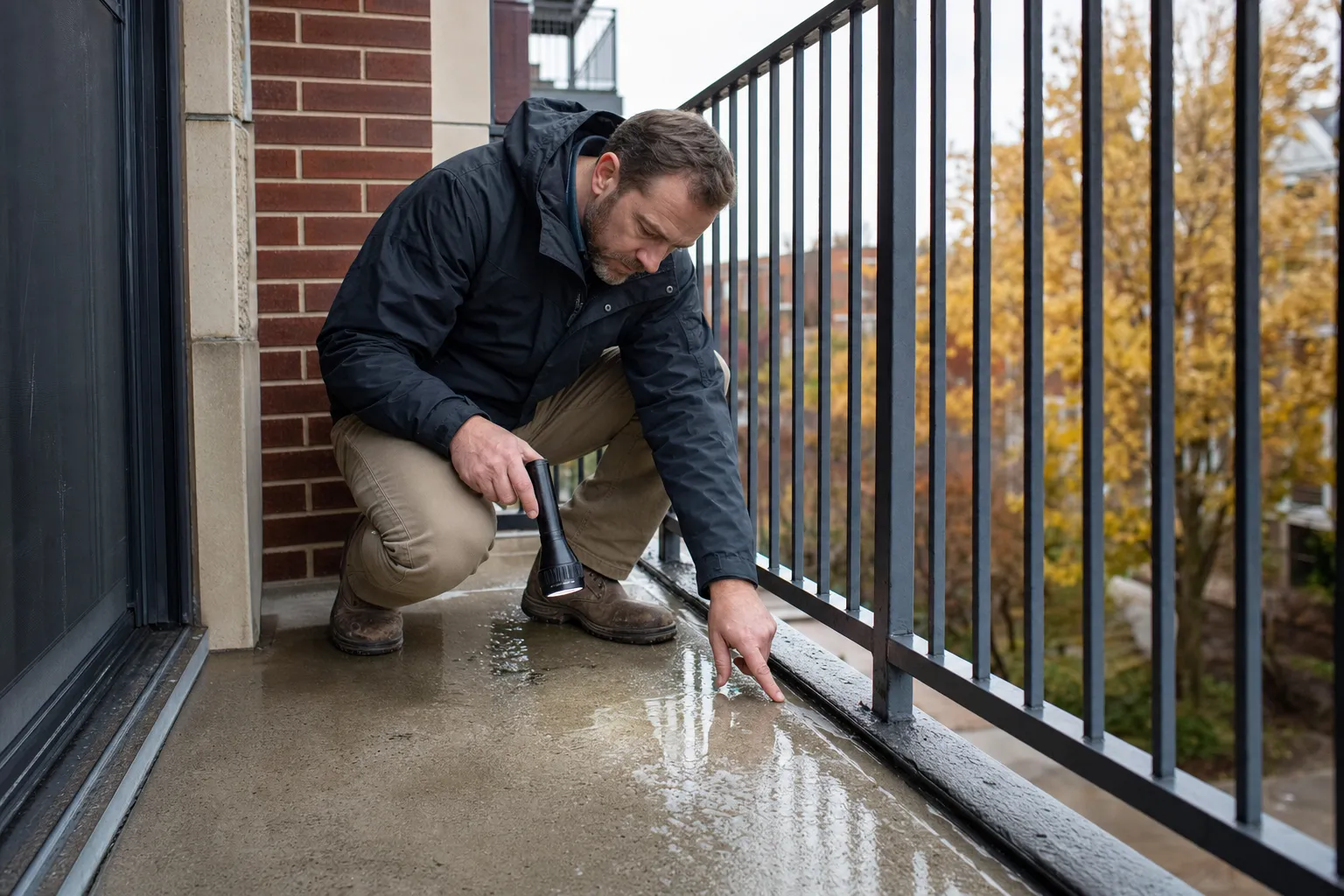
Call a professional when you see any cracking at deck joints, staining on the ceiling below the balcony, or visible gaps around railing posts. These signs mean water is already moving through the assembly. Don't wait for interior water staining to appear. By the time that's visible, the framing has already been wet repeatedly.
After any hail event or major wind storm, a balcony deck surface should be inspected for new impact damage or lifted flashing. North Iowa's severe storm season runs April through September, and high-wind events across the flat terrain of Cerro Gordo County regularly lift flashing and open seams at exposed deck edges. We'd rather you call us right after a storm than six months later when the damage is deeper.
If a deck has only ever had sealers applied and sits over a living space, a professional inspection is the right starting point even without visible symptoms. A qualified contractor will assess the deck before recommending any membrane system, not just re-seal the surface.
Owner-operated contractors with direct site experience are best positioned to correctly diagnose balcony waterproofing problems in older North Iowa building stock. A contractor managing work remotely through subcontractors can't evaluate substrate condition, slope, or transition detail the same way someone physically present on the deck can.
What does a professional balcony waterproofing inspection cover?
A thorough balcony waterproofing inspection should cover each of the following:
- Slope and drainage — Is water moving off the deck surface, or sitting at low points?
- Joint and crack condition — Are existing joints sealed, cracked open, or missing grout entirely?
- Flashing integrity — Is the flashing at wall transitions and railing post bases intact, lifted, or absent?
- Substrate moisture content — Is the deck substrate wet beneath the surface, indicating active water intrusion?
- Interior evidence — Are there stains, soft spots, or mold odors in the room directly below the deck?
A written inspection report with photos documents existing conditions before any work begins. That record is also useful if an insurance claim becomes relevant after hail or storm damage opens new penetration points in the deck assembly.
What the answer comes down to
Any Mason City balcony over a living space needs a membrane system, not a surface sealer. With 140-plus freeze-thaw days per year, an unprotected deck assembly will fail. How much structural damage builds up before the problem becomes visible is what changes depending on the details.
Retrofit waterproofing costs far less than repairing structural framing, replacing interior ceilings, or remediating mold after water has moved through an unprotected deck. Visible joint cracking, staining below the deck, or a sealer-only treatment history are the clearest signs it's time to act. A professional inspection through what freeze-thaw cycles do to an unprotected balcony deck is the right first step.